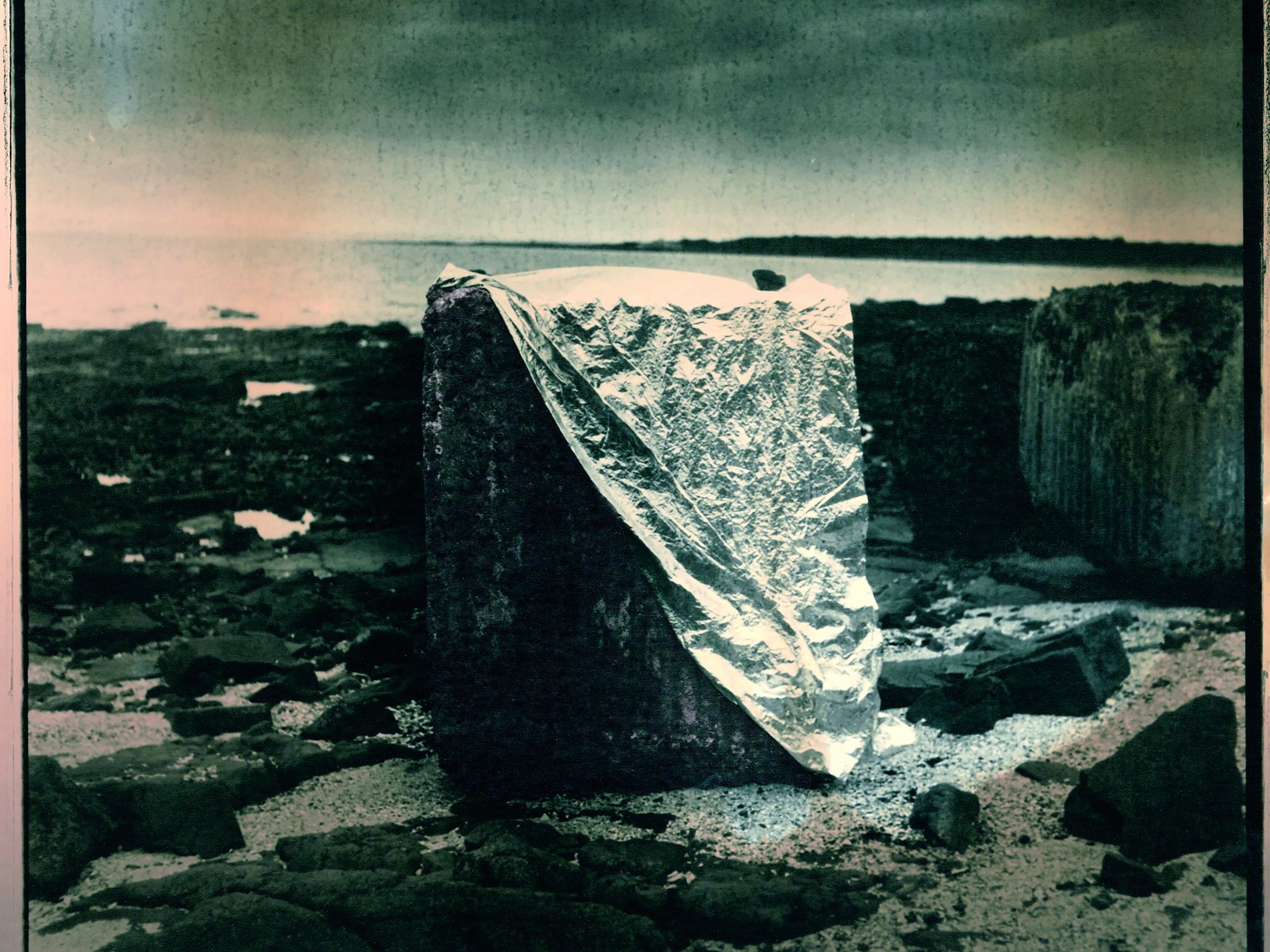
‘Universal Threshold ( UNDER B E T W E E N after before)’ 2024-25. © Wendy Hardie
Photofringe Festival 2026 has selected twenty international photographic artists from an international open call to form Open Eco 2026, an open air, open access exhibition at the Seafront Gallery in Brighton. The artists were asked to present one work in response to the question,
‘HOW CAN PHOTOGRAPHY MAKE A DIFFERENCE TO THE CLIMATE CRISIS?’
Photofringe’s Statement:
Rather than offering one answer, the exhibition brings together twenty perspectives on a rapidly changing world. The photographs move between intimate encounters with place and landscape, observations of environmental change, questions of responsibility and extraction, experiences of loss and displacement, and visions of resilience, adaptation and possible futures.
Some draw our attention to what is already changing around us; others ask us to consider what might be lost, what might endure, and what kinds of futures we are capable of imagining. Together, they demonstrate photography’s ability to not only document environmental change but also to make complex and often distant issues feel immediate and personally tangible.
The single-image format also asks us to consider what a photograph can do within a wider conversation. An image can act as evidence, testimony, warning or invitation. It can make visible what is overlooked, connect a local experience to a global condition, or encourage us to look again at the environments we inhabit every day. Across the exhibition, the photographs create a conversation that moves between warning, observation, imagination, resistance and hope.
This is where OPEN ECO connects to Feedback Loop, the theme of Photo Fringe 2026. A feedback loop is shaped by exchange: one action produces a response, which in turn produces another.
Wendy Hardie’s Artist Statement for Open Eco:
This photograph by artist Wendy Hardie was captured on a beach in east Scotland near the birthplace of John Muir, father of environmental conservation and America’s National Parks. On the wooded, rocky coast stand eroded remnants of World War 2 coastal defenses, giant, hand-cast, anti-tank, concrete blocks forming chains of resistance against fascist invasion by sea. These haunting, sculptural forms are profoundly elegiac metaphors. They hold within them and between them, fragile collective resistance, against human, and now human and environmental degradation, articulating the urgent need to comprehend the porosity of all life. The artist created the original analogue print with a WW2 era press camera and homemade, site specific botanical photographic developers.
Artist Bio:
Wendy Hardie is a multi awarded environmental artist and emerging expanded photographer and curator based in London and Scotland. Hardie’s photography employs alternative analogue processes embedded in or created with performative, sculptural & installation based forms, increasingly working with sustainable methods, materials and plant based recipes. With a passion for the land forged through an intensely immersive childhood on a Scottish farm, then a degree and diploma in architecture, her phenomenological practice focuses on poetic spatial, human narratives and humanity’s relationship to our critically fragile Anthropocene environment. Exhibiting and published nationally, Hardie had four environmental photographic works shortlisted for this year’s Royal Photographic Society’s International Photography Exhibition.
Press:
The exhibition in it’s opening week has been selected by The Guardian as a current favourite exhibition to view, alongside The Aesthetica Magazine and Art of Change 21.

